Cart 0

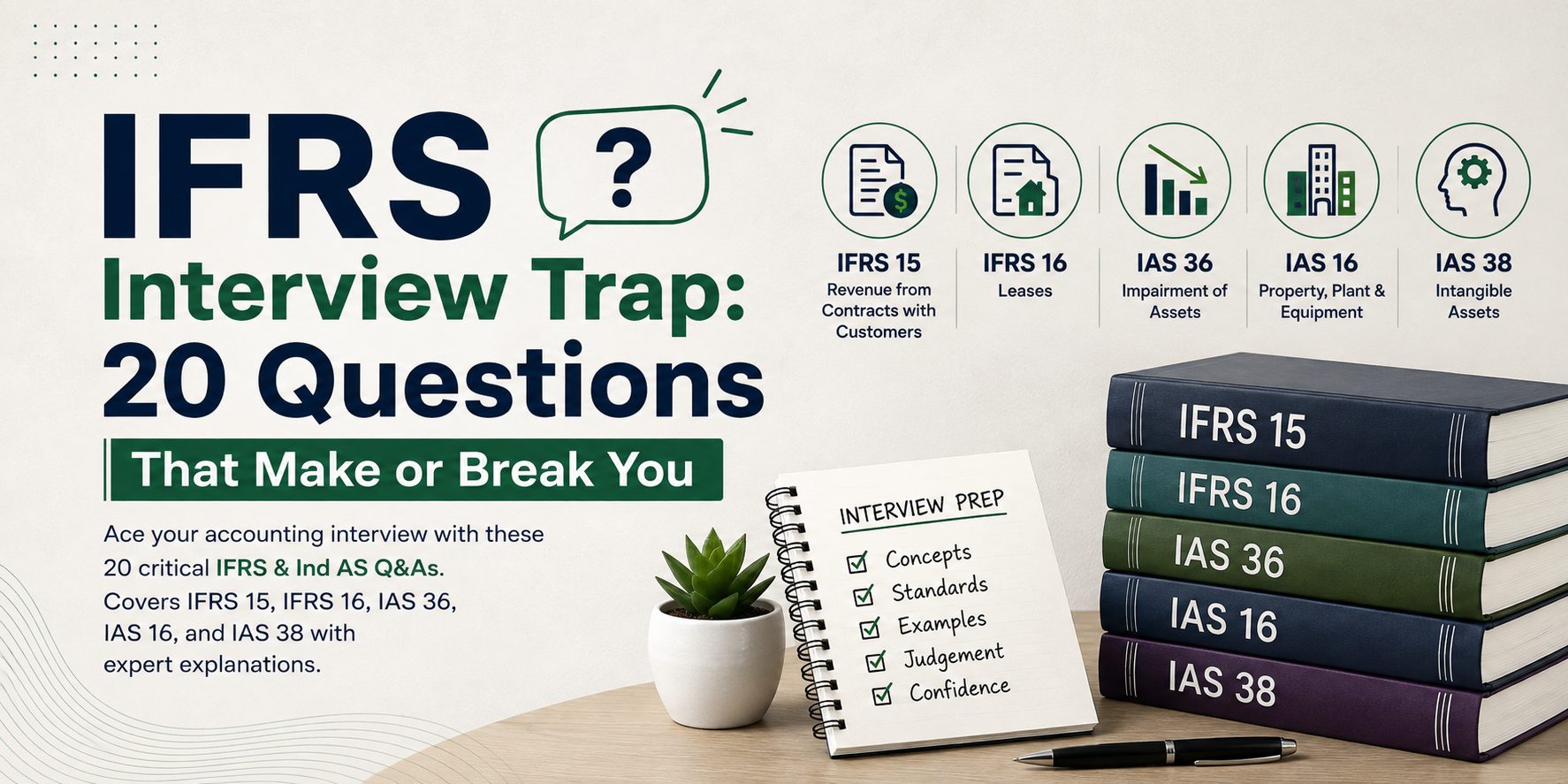

Mastering IFRS concepts is crucial for any role in accounting and finance department. Interviewers test your ability to explain principle-based accounting standards and complex issues practically.
Preparing for a finance interview requires a deep understanding of core standards. Before diving into specific Q&As, you can review our full IFRS & Ind AS Standards Compliance Guide for an end-to-end breakdown of financial reporting rules.
Here are the top 20 interview questions and answers, categorized by key accounting standards Under IFRS:
➢ IFRS 15 / Ind AS 115: Revenue from Contracts with Customers:
Q.1. Can you list the five-steps provided in the framework under IFRS 15?
Answer: Five step model under IFRS 15:
- Identify the contract(s) with a customer
- Identify the performance obligations in the contract
- Determine the transaction price
- Allocate the transaction price to the performance obligations
- Recognize revenue when (or as) the entity satisfies a performance obligation
Q.2. What is the difference between recognizing revenue "over time" vs. "at a point in time"?
Answer: Revenue is recognized over the period of time if:
-
the customer simultaneously receives and consumes benefits as the entity performs
on the contract, or -
if the asset being created or enhanced by the entity which is controlled by the
customer, or -
the asset is being created which is not controlled by the customer with no alternative
use to the entity and the entity has an enforceable right to receive payment.
Q.3. How to account for variable consideration like discounts, rebates, performance incentives / bonuses are accounted under IFRS 15?
Answer:
Variable consideration is included in the transaction price (total consideration under contract) only to the extent that it is highly probable that a significant reversal in the amount of cumulative revenue recognized will not occur when the uncertainty is resolved.
Q.4. How to measure revenue which is recognised ‘over the period of time’?
Answer:
Revenue which is eligible to be recognised over the period of time shall be measured based on percentage completion using either input method or output method which best depicts the measure for transfer of performance obligations to the customer. Input method requires the application of ratio of costs incurred till date that bears with total estimated contract costs to the transaction price calculated in step 3. Output method requires an inspection report by an expert on percentage completion.
➢ IFRS 16: Leases
Q.5. What are the major changes introduced by IFRS 16?
Answer:
IFRS 16 introduced changes mainly in the Lessee accounting. Standard eliminated the classification of leases as either operating or finance leases in the books of lessee. Instead, it introduces a single on-balance sheet model. Lessees must recognize a right-of-use (ROU) asset and a corresponding lease liability for all leases (with exemptions for short-term leases or low-value assets).
Q.6. Is there any exemption for lessee under IFRS 16 from accounting for ROU asset and Lease liability?
Answer : Lessee can get an optional exemption under IFRS 16 in two scenarios:
- When lease is a short-term lease, i.e. is less than 12 months
-
When lease contract is for a low value item i.e. value of an item under contract
when new is approximately USD 5,000 or less individually.
Q.7. How to calculate Lease liability and ROU asset in the books of Lessee?
Answer:
Lease liability is the present value of the future contractual lease payments discounted using appropriate discounting factor. ROU asset is total of lease liability plus any lease prepayments, initial direct cost adjusted by lease incentives received or receivable.
Q.8. Which discount rate is used to calculate the lease liability?
Answer:
A company should use the interest rate implicit in the lease. This is possible for the lessor. If that rate cannot be readily determined for lessee, then lessee’s incremental borrowing rate should be used.
Q.9. How is the Right-of-Use (ROU) asset depreciated?
Answer:
The ROU asset is generally depreciated on a straight-line basis from the commencement date to the earlier of the end of the useful life of the ROU asset or the end of the lease term.
➢ IAS 36: Impairment of assets
Q.10. How do you define impairment under IAS 36?
Answer:
Impairment occurs when the carrying amount of an asset (or cash-generating unit) exceeds its recoverable amount. The recoverable amount is the higher of an asset’s Fair Value less Costs to Sell and its Value in Use.
Q.11. How is 'Value in Use' calculated?
Answer:
Value in Use is the present value of the future cash flows expected by an entity to be derived from an asset or cash-generating unit. It involves estimating future cash inflows/outflows and applying an appropriate pre-tax discount rate.
Q.12. How to calculate ‘Fair value less costs to sale’?
Answer:
Fair value is the value calculated using IFRS 13 principles based either on Market approach or Income approach or Cost approach using Level 1 to 3 inputs for valuation information. From that amount, cost to sale is required to be deducted on an estimated basis as this is a hypothetical transaction.
Q.13. In many cases calculation of fair value is not possible using market approach. In such cases entity uses income approach (present value of future cashflows) to calculate fair value of an asset or a CGU. How such fair value is different from ‘value in use’ in calculating recoverable amount?
Answer:
While calculating fair value using income approach, cash flows are estimated from the perspective of market participants (highest and best use) however, while calculating value in use, cash flows are estimated 2from the perspective of entity (entity specific use).
Q.14. How to account for impairment loss in the financial statements?
Answer:
Impairment loss is accounted as debit to the statement of profit and loss. In some cases, it may be debited to revaluation reserve, provided there is balance in revaluation reserve with respect to the asset in question. Such loss is allocated first to write off goodwill, if any, allocated on CGU and then on the assets within the CGU which are within the measurement scope of IAS 36 in the ratio of their carrying values.
Q.15. Can an impairment loss be reversed in subsequent periods?
Answer:
Yes, for assets other than goodwill, an impairment loss can be reversed if there has been a change in the estimates used to determine the asset’s recoverable amount since the last impairment loss was recognized. However, once goodwill is written off initially, reversal of such loss on goodwill is strictly prohibited.
➢ IAS 16 : Property, Plant and Equipment (PPE)
Q.16. How PPE shall be measured initially on its recognition and what all amounts can form part of that cost if purchased externally?
Answer:
PPE shall be measured at its “Cost”. Cost shall be measured to include expenses such as purchase price + non-refundable taxes + all directly attributable expenses (viz. transport expenses, loading unloading expenses, site preparation expenses etc.) + borrowing costs (as per IAS 23 – Borrowing costs) + dismantling and restoration costs and shall exclude any rebates and discounts received and imputed cost of interest in case of deferred payment.
Q.17. What are the two measurement models available for subsequent measurement of PPE?
Answer:
Cost Model: The asset is carried at cost less accumulated depreciation and accumulated impairment losses.
Revaluation Model: The asset is carried at a revalued amount (fair value at the date of revaluation) less any subsequent accumulated depreciation and impairment losses. Revaluation gain generally accounted in OCI and revaluation loss is generally accounted in the statement of P&L.
Q 18. What is the difference between property being land or building classified under PPE (IAS 16) and classified under Investment Property (IAS 40)?
Answer:
Property being land or building used in the production or supply of goods/services, or for administrative purposes is considered as used for own purposes and is accounted under IAS 16. However, property being land or building, rented to third party for their use or held for capital appreciation (not for own use) is accounted for as investment property under IAS 40.
➢ IAS 38 / Ind AS 38: Intangible Assets (IA)
Q.19. What are the criteria for recognizing an internally generated intangible asset?
Answer: Under IAS 38, development costs can only be capitalized if the entity can demonstrate all of the following (the PIRATE criteria):
- Probable future economic benefits.
- Intention to complete and use/sell it.
- Resources (technical, financial) available to complete the IA.
- Ability to use or sell the asset.
- Technical feasibility of completion.
- Expenditure can be measured reliably.
Q.20. How intangible assets are measured initially and subsequently on reporting date?
Answer:
Intangible assets (IA) are measured at Cost on initial measurement date.
On subsequent measurement dates, IA are categorised as “IA with definite useful life” and “IA with indefinite useful life” and “Goodwill”.
IA with definite useful life – similar to PPE, they can be measured at Cost model (Cost less accumulated amortisation and impairment loss) or revaluation model, provided IA has active market.
“IA with indefinite useful life and Goodwill” are measured at cost model with no amortisation, however, such assets will be tested for impairment on two levels; first at least once in a year irrespective of impairment indications (this is in lieu of amortisation) and second whenever indication occurs.
Conclusion
Preparing for a finance interview requires practicing how you articulate complex standards simply. Reviewing these revenue recognition, lease accounting, and asset valuation principles will help you answer confidently when put on the spot.
Have a specific IFRS accounting scenario or interview question you'd like us to cover? Drop your question in the comments below!
39 Views